
CO2 Introduction Podcast & Resources
In this episode of the podcast, Bryan talks with Andre Patenaude from Emerson about CO2 refrigeration, and transcritical booster systems. Modern CO2 systems are efficient and effective due to their electrical controls and components, including case and high-pressure controls.
Carbon dioxide (CO2) is a good refrigerant to address global climate change. From a sustainability standpoint, carbon dioxide is a superior refrigerant to HCFCs and HFCs. Carbon dioxide is also an A1 refrigerant, meaning that it is non-toxic and non-flammable. It is also inexpensive and compares to HFCs in cost. Unfortunately, it can rapidly change pressures and is more efficient in lower ambient temperatures. Overall, CO2 is a desirable refrigerant as we address the challenge of sustainability but is not without its challenges.
During the refrigeration cycle, carbon dioxide’s critical point comes into play. In hotter ambient temperatures, the carbon dioxide’s temperature and pressure may exceed the critical point. The refrigerant then becomes a supercritical fluid; the pressure and temperature change independently of each other. Accessing the supercritical zone is also known as “transcritical.”
Carbon dioxide refrigeration is best for low-temperature grocery refrigeration. It has also worked its way into industrial refrigeration.
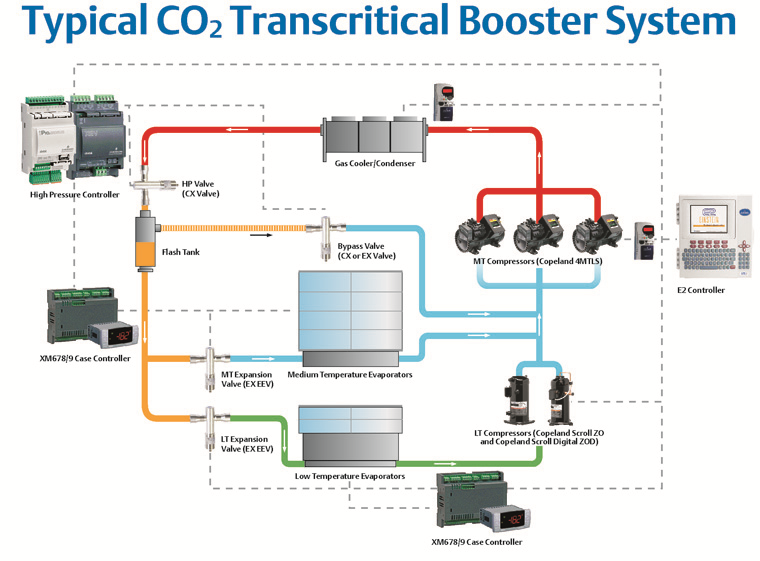
However, the greatest challenge revolves around the condensing temperature. Carbon dioxide must reject its heat to something that is much colder than it. A transcritical booster system’s condenser becomes a gas cooler in the summer; instead of leaving the condenser as a liquid, a CO2 system leaves the gas cooler as a supercritical fluid. It becomes liquid when it passes through an electronic expansion valve (EEV) before the receiver. The CO2 refrigeration system also contains a flash tank and a bypass valve. The bypass valve partially dictates which compressor the refrigerant fluid travels to. There are also low and medium-temperature evaporators and compressors.
Resources
Seven Keys to Servicing CO2 Systems – Article by Andre
CO2 Booster Systems Introduction – Article by Bryan
Cascade Refrigeration – Article by Bryan

Author:










Comments
To leave a comment, you need to log in.
Log In