
The Chemistry of Combustion w/ Rachel Kaiser
Make & share a podcast clip
Keep the exact passage and a link to the full episode. Choose up to three minutes, with enough context to be fair to the speaker.
Preview uses this episode’s audio. Browser audio export, when supported, takes the length of the selected clip. Nothing plays until you choose Preview.
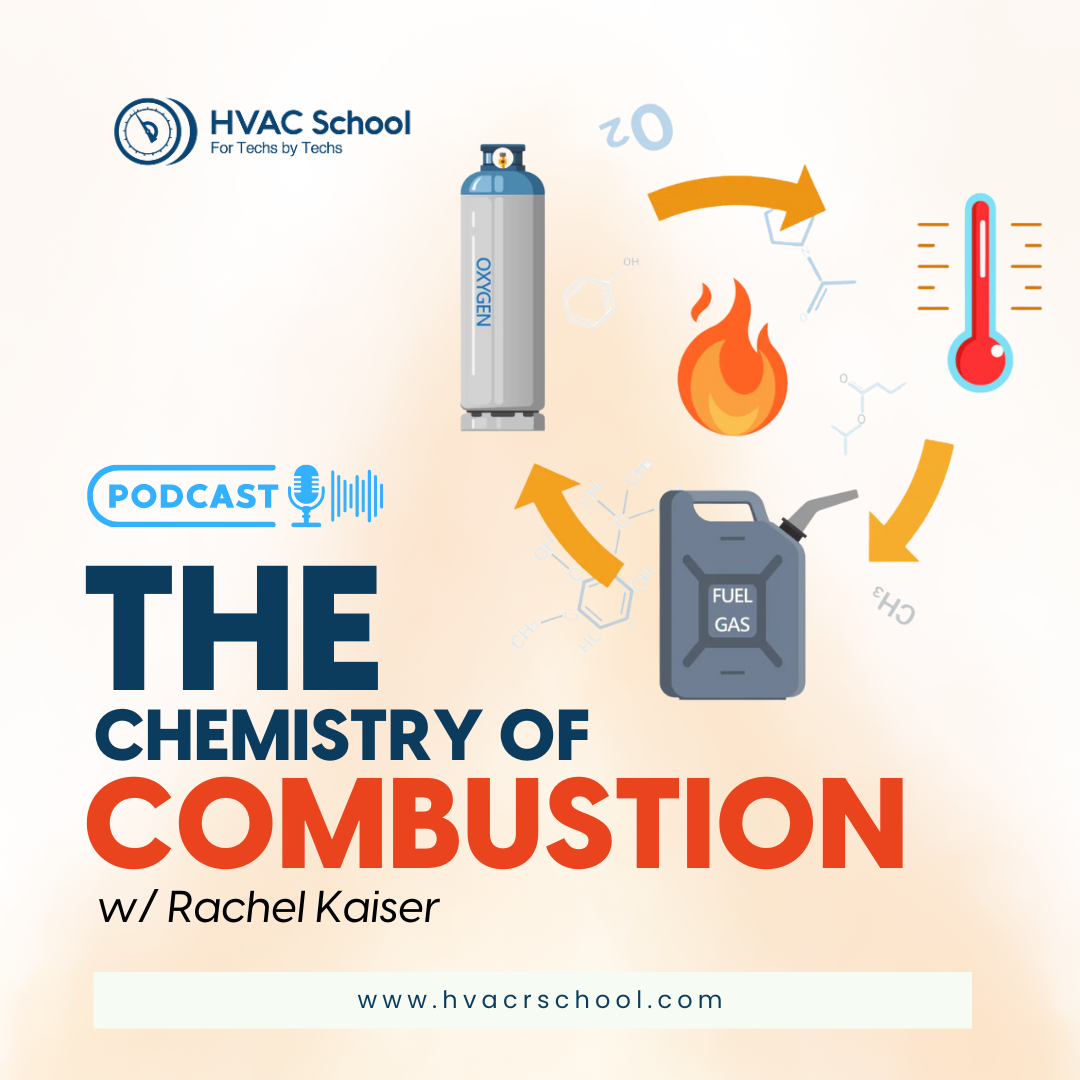
In this episode of the HVAC School Podcast, Bryan interviews Rachel Kaiser, a chemist with a passion for making science more accessible and understandable, especially when it comes to the topic of combustion. Rachel shares her background of how her family’s restaurant business sparked her early interest in chemistry and the science behind mixing ingredients to produce desired results.
Rachel dives deep into explaining the fundamental chemistry behind the combustion process. She breaks down the three key components required for combustion to occur – fuel, oxygen, and a heat source – and how the ideal chemical reaction is represented. However, she emphasizes that in the real world, factors like using natural gas (a mixture of gases) as fuel instead of pure methane and air (also a mixture) as the oxygen source lead to incomplete and imperfect combustion reactions.
The discussion highlights the importance of combustion analysis and monitoring for byproducts like carbon monoxide (CO) and nitrogen oxides (NOx). Rachel stresses that testing is crucial not just for technician safety but to ensure proper combustion for occupants as well. High CO levels, for instance, indicate incomplete combustion and the likely presence of other undesirable compounds.
Topics covered include:
Connect with Rachel on LinkedIn and ask her more about chemistry in HVAC HERE. You can also view her presentation from the 5th Annual HVACR Training Symposium and/or purchase your virtual ticket to all sessions HERE.
Have a question that you want us to answer on the podcast? Submit your questions at https://www.speakpipe.com/hvacschool.
Purchase your tickets or learn more about the 6th Annual HVACR Training Symposium at https://www.hvacrschool.com/symposium.
Subscribe to our podcast on your iPhone or Android.
Subscribe to our YouTube channel.
Check out our handy calculators here or on the HVAC School Mobile App for Apple and Android.
Highlight a short passage, or bring a question about a specific moment into HVAC No Bull Forum.
Discuss this reference → Related forum discussionsAuthor:












Comments
To leave a comment, you need to log in.
Log In