
ERV & HRV – Short #148
Make & share a podcast clip
Keep the exact passage and a link to the full episode. Choose up to three minutes, with enough context to be fair to the speaker.
Preview uses this episode’s audio. Browser audio export, when supported, takes the length of the selected clip. Nothing plays until you choose Preview.
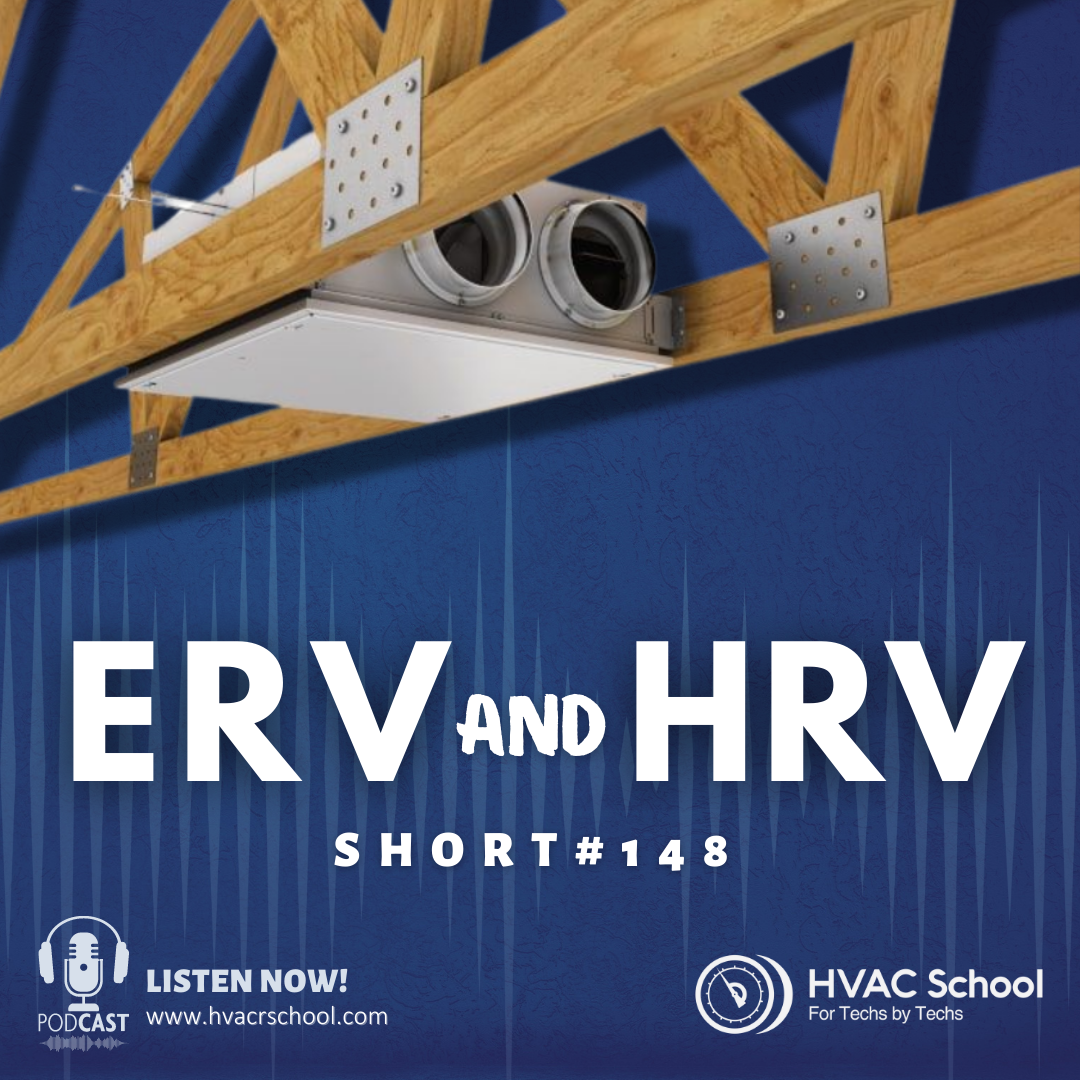
In this short podcast episode, Bryan talks about ERV and HRV technologies, including their appropriate applications and limitations.
HRVs are heat recovery ventilators (not to be confused with heat recovery units or HRUs), and ERVs are energy recovery ventilators. The main difference between these two lies in the type of heat they move; HRVs only move sensible BTUs, whereas ERVs move sensible and latent BTUs.
As you bring air in from outside, you’re discharging roughly the same amount of air (though modern technologies allow you to manipulate the pressure a bit more). The goal of the HRV or ERV is to recover some energy from the air exiting the structure and incorporate it into the incoming airstream. The airstreams cross over each other, and there is heat transfer but not air mixing. (ERVs also allow for the exchange of moisture.) Two fans drive the direction of energy flow, and a mesh or a porous desiccant medium facilitates the interaction between the airstreams.
You will get some energy savings with an HRV or ERV, but savings are dictated by the amount of air moved and the temperature differential between the airstreams. In general, you will see HRVs up north (in low-humidity markets) and ERVs down south (in higher latent-heat markets). However, even ERVs aren’t very effective in conditions with low energy transfer and high moisture UNLESS they’re used with a ventilating dehumidifier.
Bringing in fresh air is good for indoor health and safety, as it helps dilute the presence of VOCs, viruses, and harmful gases. HRVs and ERVs help us manage the air we bring in.
Bryan also covers:
- Integrating ERVs with bathroom ventilation
- Safety considerations to consider for outdoor air
- Positive pressurization
- Demand ventilation with CO2 sensors
- Learning about ASHRAE 62.2
If you have an iPhone, subscribe to the podcast HERE, and if you have an Android phone, subscribe HERE.
Check out our handy calculators HERE.
Highlight a short passage, or bring a question about a specific moment into HVAC No Bull Forum.
Discuss this reference → Related forum discussionsAuthor:











Comments
To leave a comment, you need to log in.
Log In