
Short #61 – EPR vs. CDS Valves
Make & share a podcast clip
Keep the exact passage and a link to the full episode. Choose up to three minutes, with enough context to be fair to the speaker.
Preview uses this episode’s audio. Browser audio export, when supported, takes the length of the selected clip. Nothing plays until you choose Preview.
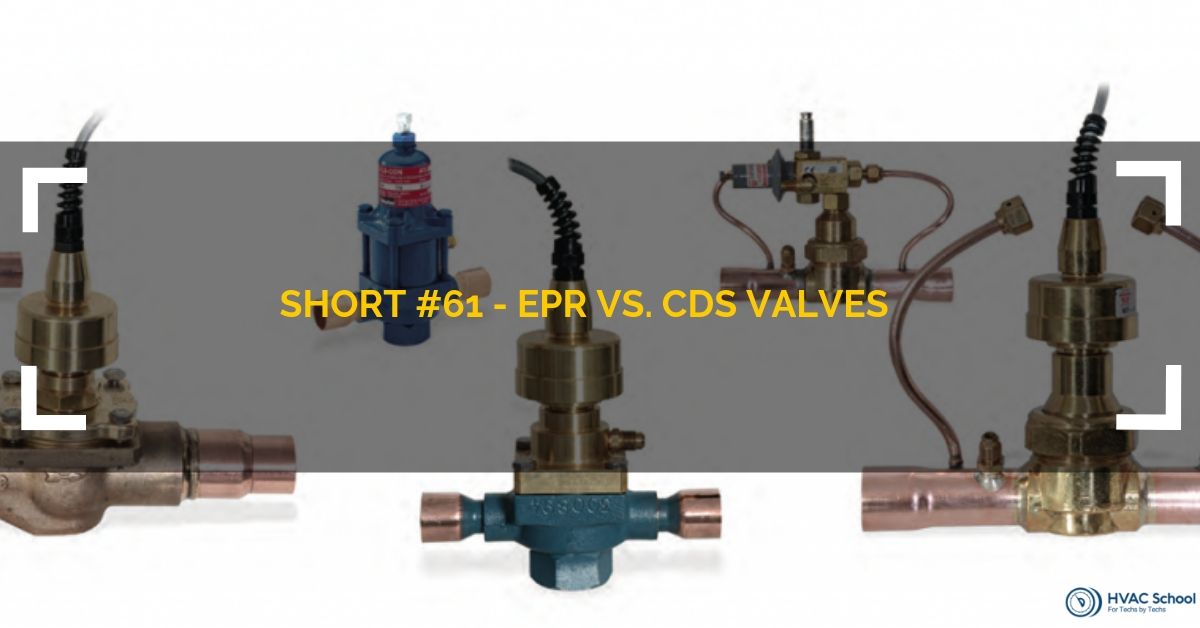
Bryan talks about EPR and CDS valves. We consider both to be evaporator pressure regulators, but they really function quite differently. CDS are Sporlan components that appear to be quite similar to evaporator pressure regulators (EPRs).
EPRs go in the suction line and control the evaporator pressure. The pressure and temperature relate to each other, so the goal is to keep the evaporator from freezing by controlling the pressure. However, EPRs rely on a pressure drop across them to be able to do their job, so compression ratios will increase, impacting power consumption. We primarily see EPR valves in supermarket refrigeration on rack systems.
Electronic EPRS (EEPRS) include the Sporlan CDS valve. However, EEPRs do NOT actually measure the pressure in the evaporator coil in the same way that a standard EPR does. (However, they are evaporator flow regulators.) The pressure of an EPR is fixed via mechanical parts, but the CDS valve relies on a signal from the controller to set targets depending on the air temperature. The CDS valve can modulate via a stepper motor to maintain a certain target.
Sporlan CDS valves have a lot of benefits. For example, you can reset or adjust the CDS valve without manually adjusting it; you can easily adjust the controls. CDS valves also don’t require a pressure drop because they do not rely on a mechanical process to work. If you encounter modulation issues with your CDS valves, you can power cycle them. Sporlan SORIT valves have a separate solenoid, but the stepper motor allows the CDS valves to close fully.
Overall, CDS setups can save a lot of energy and are quite easy to use because of their integration with controls. Unfortunately, they are prone to failure from power surges.
Learn more about Refrigeration Technologies HERE.
Highlight a short passage, or bring a question about a specific moment into HVAC No Bull Forum.
Discuss this reference → Related forum discussionsAuthor:











Comments
To leave a comment, you need to log in.
Log In