
Q&A – EPR and Pressure Limiting Valves w/ Matthew Taylor
Make & share a podcast clip
Keep the exact passage and a link to the full episode. Choose up to three minutes, with enough context to be fair to the speaker.
Preview uses this episode’s audio. Browser audio export, when supported, takes the length of the selected clip. Nothing plays until you choose Preview.
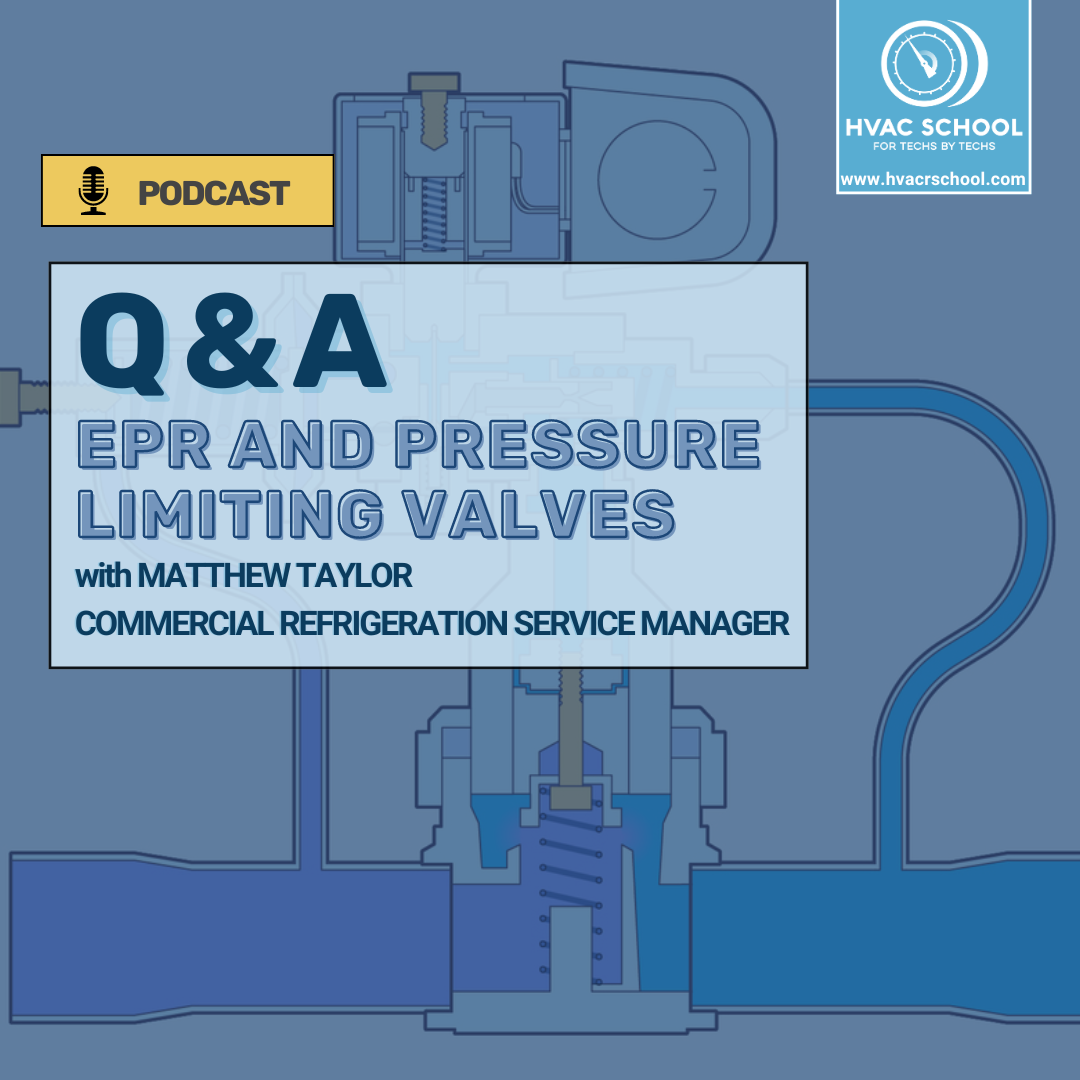
In this episode, Matthew Taylor joins the podcast to dive deep into the world of pressure-limiting valves and regulators used in refrigeration and air conditioning systems. They explore the intricacies of Maximum Operating Pressure (MOP) expansion valves, Evaporator Pressure Regulators (EPR), and Crankcase Pressure Regulators (CPR), discussing their functions, applications, and differences.
The conversation begins with an explanation of MOP expansion valves, which are commonly used in low-temperature refrigeration applications and air conditioning systems. Matthew describes how these valves work by using a vapor-charged thermal element to limit the suction pressure, protecting compressors from operating outside their designed range. They discuss the differences between liquid-filled, vapor-charged, and cross-charged valves, highlighting how each type affects system performance and superheat control.
The discussion then shifts to larger systems and rack refrigeration, where Crankcase Pressure Regulators (CPRs) are preferred over MOP valves. Matthew explains how CPRs control pressure closer to the compressor, allowing for better superheat control in systems with longer piping runs. The conversation concludes with an explanation of Evaporator Pressure Regulators (EPRs), which are used in multi-evaporator systems to maintain specific evaporator temperatures independently of the overall system suction pressure.
Topics covered in the podcast:
- Maximum Operating Pressure (MOP) expansion valves
- Liquid-filled vs. vapor-charged thermal elements
- Cross-charged valves and superheat control
- Applications of MOP valves in small refrigeration systems and air conditioning
- Crankcase Pressure Regulators (CPRs) for larger systems
- Evaporator Pressure Regulators (EPRs) for multi-evaporator setups
- Differences between MOP, CPR, and EPR in pressure control
- Challenges of pressure control in rack refrigeration systems
- Impact of pressure-limiting devices on compressor longevity
- Considerations for technicians when working with different types of systems
Have a question that you want us to answer on the podcast? Submit your questions at https://www.speakpipe.com/hvacschool.
Purchase your tickets or learn more about the 6th Annual HVACR Training Symposium at https://www.hvacrschool.com/symposium.
Subscribe to our podcast on your iPhone or Android.
Subscribe to our YouTube channel.
Check out our handy calculators here or on the HVAC School Mobile App for Apple and Android.
Highlight a short passage, or bring a question about a specific moment into HVAC No Bull Forum.
Discuss this reference → Related forum discussionsAuthor:












Comments
To leave a comment, you need to log in.
Log In