
Mini Split Install and Service Tips
Make & share a podcast clip
Keep the exact passage and a link to the full episode. Choose up to three minutes, with enough context to be fair to the speaker.
Preview uses this episode’s audio. Browser audio export, when supported, takes the length of the selected clip. Nothing plays until you choose Preview.
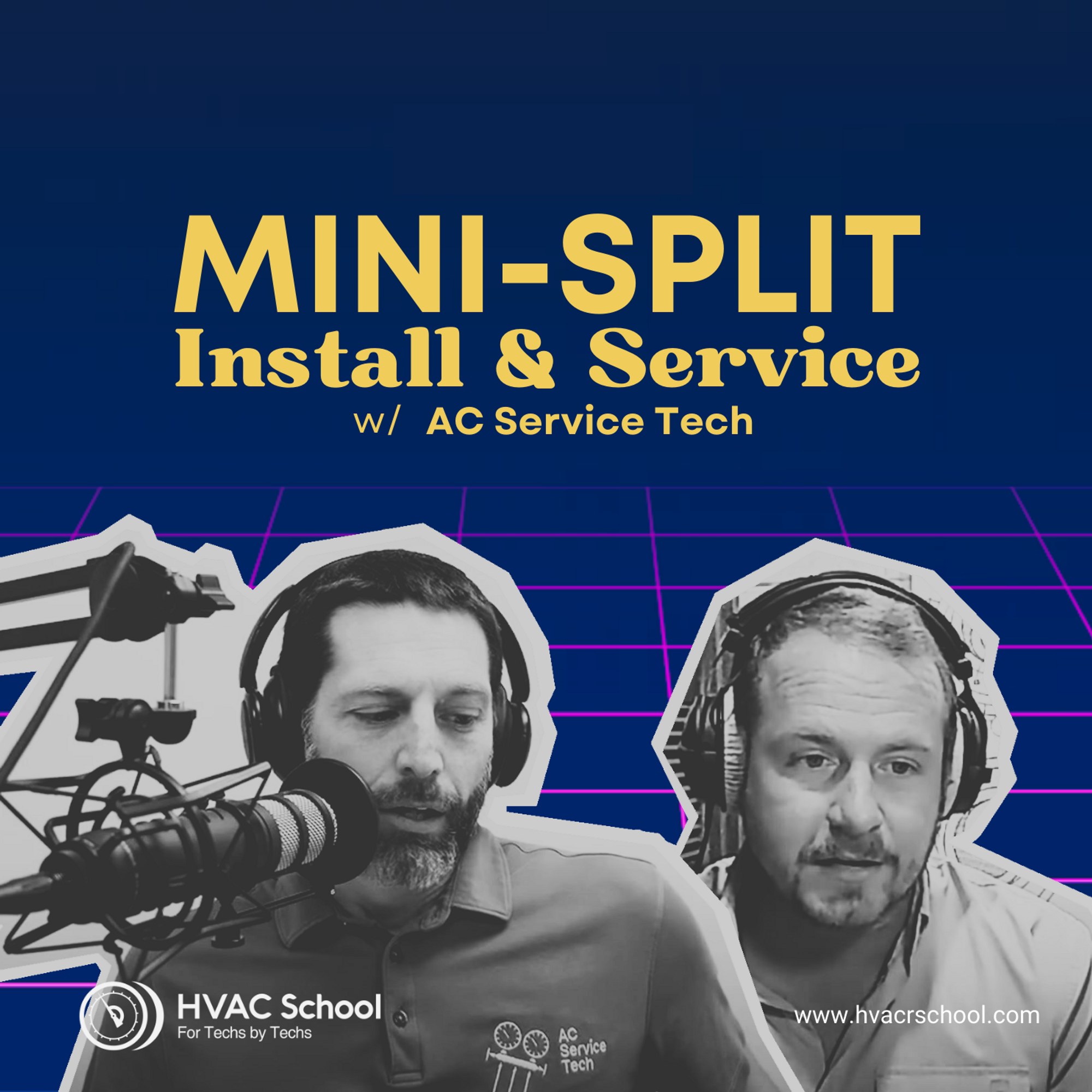
Craig Migliaccio, aka AC Service Tech, returns to the podcast to share his knowledge about mini-split install & service. He also talks a bit about his upcoming book, “Inverter Mini-Split Operation and Service Procedures.”
Mini-splits are unique because they are compartmentalized in ways that traditional central-air ducted systems are not. Mini-splits come in many varieties, including ducted and ductless types, as well as multi-zone types. Many are inverter-driven and have more electrical efficiency as a result and can vary their capacities based on load variation.
Mini-splits have metering devices at their outdoor units, and these devices may be electric expansion valves (EEVs) or capillary tubes. Inverter mini-splits also don’t have filter driers because their PVE oil doesn’t have the same acid concerns as POE oil, and they don’t have traditional liquid lines.
Flare connections are also critical when installing ductless systems, especially because you want systems to be tight to prevent leaking and contamination. Craig likes eccentric flaring tools with offset cones, and he recommends using flare nuts from the equipment manufacturer, not the line set manufacturer. He covers other flaring best practices as well.
The charge is quite small in mini-splits, so weighing the charge and being careful and deliberate during charging is critical. Refrigerant leaks can also be highly problematic; corrosion and poor flare connections are common causes of leaks.
Craig and Bryan also discuss:
- Hyper-heat systems
- Coefficient of performance (COP) and BTU output
- Moving between PSC and ECM or inverter technologies
- Mini-splits vs. VRF/VRV technologies
- Pressure testing and leak detection
- Compressor diagnosis
- Thermistors and electrical resistance
- Heat sinks and mounting circuit boards
- Selecting a location to install a mini-split
- Things to consider when checking the charge
- Why measure superheat and subcooling?
- Cleaning and maintenance best practices
Check out Craig’s YouTube channel at https://www.youtube.com/@acservicetech.
Starting January 1st, 2023, you can buy Craig’s book on his website, which has a bunch of other good resources. Visit that site at https://www.acservicetech.com/.
If you have an iPhone, subscribe to the podcast HERE, and if you have an Android phone, subscribe HERE.
Check out our handy calculators HERE.
Highlight a short passage, or bring a question about a specific moment into HVAC No Bull Forum.
Discuss this reference → Related forum discussions








Comments
To leave a comment, you need to log in.
Log In