
Key System Performance Factors – Short 124
Make & share a podcast clip
Keep the exact passage and a link to the full episode. Choose up to three minutes, with enough context to be fair to the speaker.
Preview uses this episode’s audio. Browser audio export, when supported, takes the length of the selected clip. Nothing plays until you choose Preview.
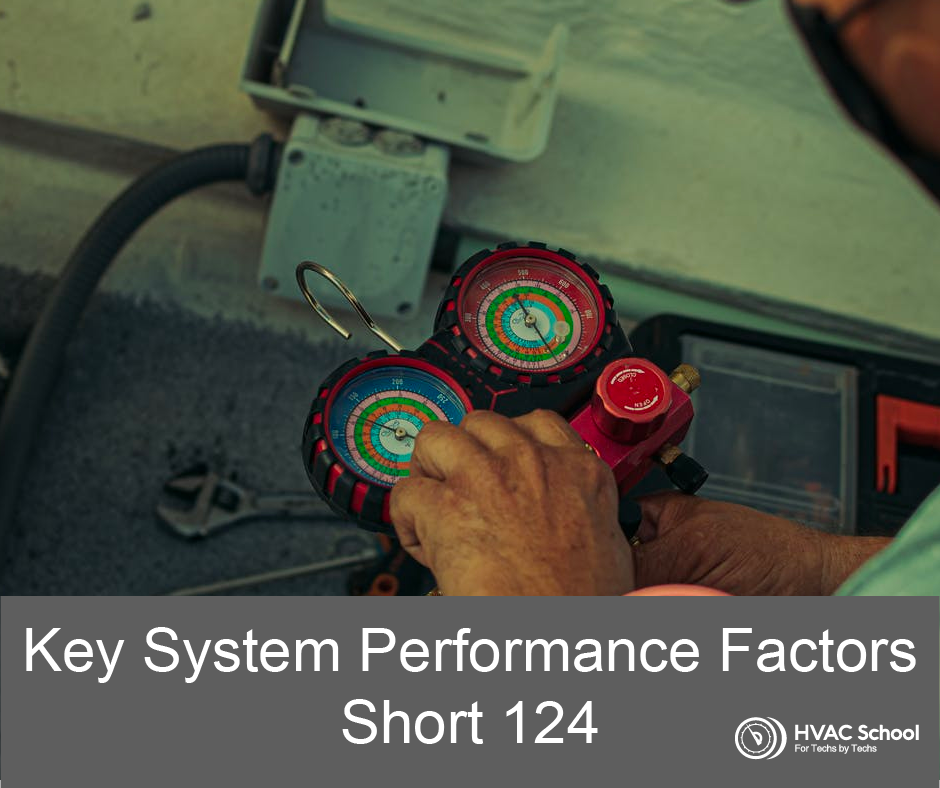
In today’s short podcast, Bryan discusses the key factors for system performance WITHOUT doing a deep dive into system commissioning. “Performance” refers to system efficiency, capacity, air filtration/cleanliness, longevity, and the ability to match the latent and sensible loads of a space.
System airflow is the main performance factor to consider. To determine proper airflow (CFM), consult Manuals S, J, and D to perform calculations. In general, the absolute lowest limit is around 275 CFM (in extreme dehumidification mode), and the highest limit should be around 525 CFM (in arid climates or at altitude).
You can determine your CFM target after you set up your ECM motor in the design. Then, you can also check airflow indicators: total external static pressure and pressure drop across the filter. The best way to improve airflow is to reduce pressure drop across the filter and build a better return plenum. For improving overall system performance, make sure the ducts are appropriately sized.
System charge is another important performance factor. There is a lot more to evaluating charge than checking the superheat and subcooling. If possible, it is a good idea to weigh the charge with a scale and see how it matches up with the line length.
In terms of long-term performance, the condenser’s location and cleanliness are also vital. Overall, a condenser works best if you put it in a slightly shaded area or on the north/east side of a building. The outdoor unit should also have some clearance from bushes and walls. Make sure the condenser is positioned away from pool equipment, water softener discharge, and dryer vent discharge. The goal is to keep the outdoor unit corrosion-free and able to “breathe.”
If you have an iPhone subscribe to the podcast HERE and if you have an Android phone subscribe HERE.
Check out our handy calculators HERE.
Highlight a short passage, or bring a question about a specific moment into HVAC No Bull Forum.
Discuss this reference → Related forum discussionsAuthor:











Comments
To leave a comment, you need to log in.
Log In