
How to Measure Total System Airflow w/ Steven
Make & share a podcast clip
Keep the exact passage and a link to the full episode. Choose up to three minutes, with enough context to be fair to the speaker.
Preview uses this episode’s audio. Browser audio export, when supported, takes the length of the selected clip. Nothing plays until you choose Preview.
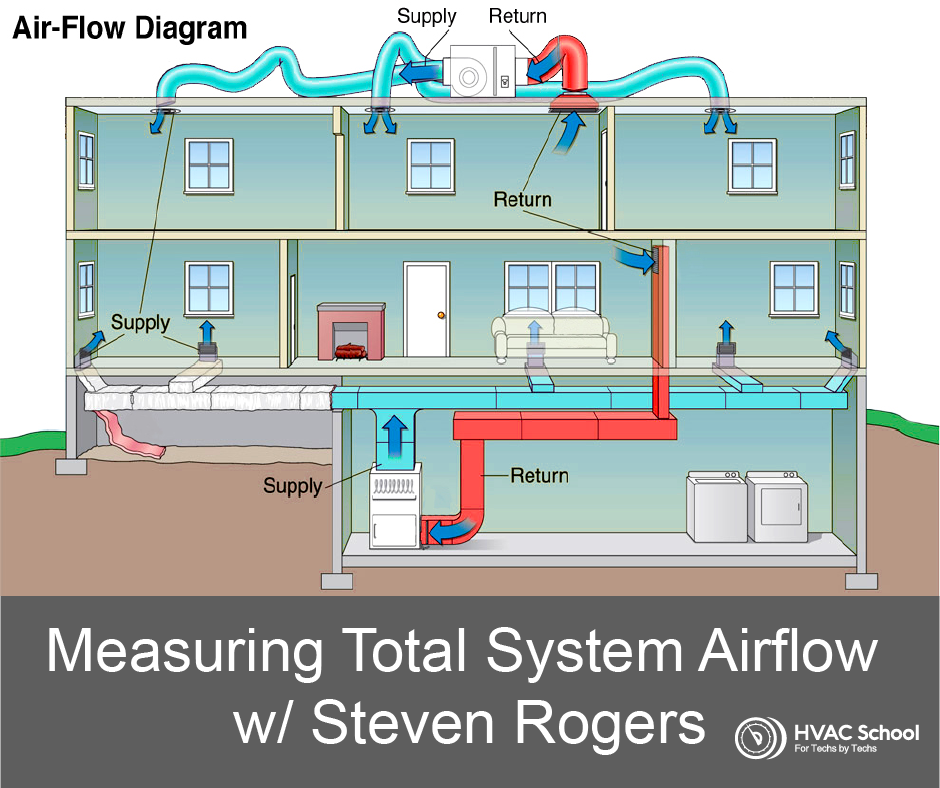
In today’s podcast, Steven Rogers joins Bryan to talk about measuring total system airflow.
Fluid measurement is NOT restricted to liquids; a fluid is anything that flows, including liquids and gases. In HVAC, we deal with both of them, but airflow is strictly limited to the flow of gas. The airflow we experience in HVAC is exclusively turbulent flow, NOT truly laminar flow.
Total system airflow is difficult to measure directly; we can use flow hoods, but they have their limitations, especially on systems that have multiple returns. So, we measure pressures that give us clues about the airflow tendencies.
One of the most recognizable measurements is static pressure. Many factors can contribute to poor static pressure, including dirty filters and poorly designed supply and return plenums.
All measurements that you use to calculate static pressure will require an average. You take readings at multiple points of the duct, so you need to calculate an average value, whether you’re using static pressure tips, a hot wire anemometer, or a vane anemometer. Measurements are also particularly difficult to take in the supply registers, as there are almost no runs of straight duct.
Recently, the TrueFlow grid has come on the scene to make airflow measurement easier. The grid relies on torque and RPM data to determine the total system airflow. The TrueFlow grid slides in where the filter goes and measures the total system airflow. The grid works with an app that considers the system tonnage to let you know how good or bad the airflow is.
Bryan and Steven also discuss:
Bernoulli’s principle
“Moving” CFM targets
Flow hood limitations
Laminar vs. turbulent flow
Static pressure probes vs. pitot tubes
TESP and fan charts
Precision vs. typical manometer
TrueFlow grid vs. filter restriction
Water heater backdraft
Depressurization and combustion air zone
Check out The Energy Conservatory’s Website HERE. You can also check out the TrueFlow grid on that site or at HERE.
Check out our handy calculators HERE.
Highlight a short passage, or bring a question about a specific moment into HVAC No Bull Forum.
Discuss this reference → Related forum discussionsAuthor:












Comments
Excelente informacion . Gracias por compartir enseñanza a los que nos apasiona todas las etapas de los a/c comfort y refrigeracion !!!
Report comment
Excelente informacion . Gracias por compartir enseñanza a los que nos apasiona todas las etapas de los a/c comfort y refrigeracion !!!
Report comment
To leave a comment, you need to log in.
Log In