
Analog & Digital Manifolds w/ James Bowman (Podcast)
Make & share a podcast clip
Keep the exact passage and a link to the full episode. Choose up to three minutes, with enough context to be fair to the speaker.
Preview uses this episode’s audio. Browser audio export, when supported, takes the length of the selected clip. Nothing plays until you choose Preview.
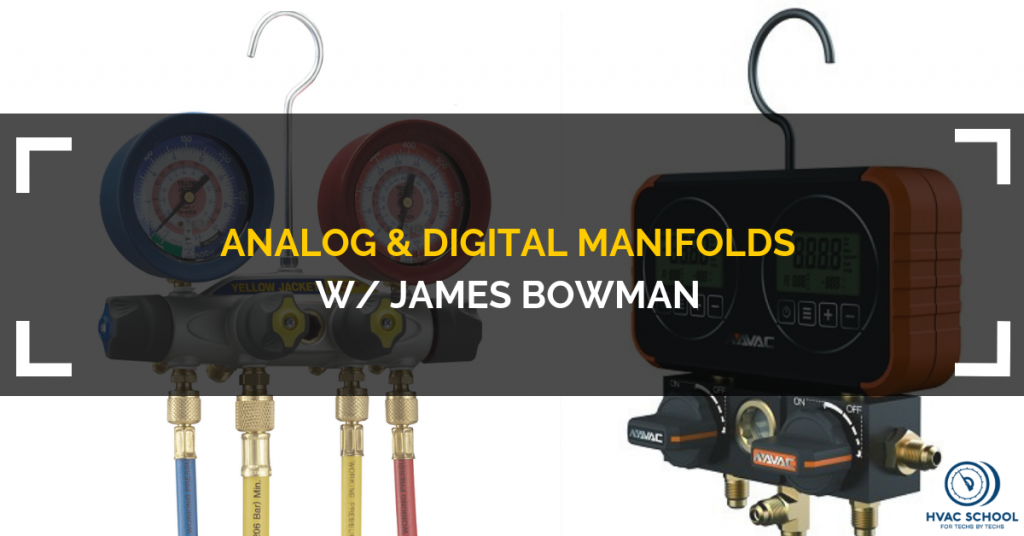
James Bowman returns to the podcast to talk about analog vs. digital manifolds. He also explains why both of them may still have a place in the industry.
Pricing is a key difference between analog and digital manifolds. Analog manifolds tend to be less expensive and will suffice just fine for techs who don’t require readings with a lot of detail. While digital manifolds will be more expensive, they can also give you more precise, detailed readings. So, digital manifolds have a slight leg-up in terms of resolution as well; these manifolds are generally better for critical-charge or MicroChannel systems.
Learning to take readings on analog manifolds early on may be advantageous for young or inexperienced techs. You learn more about superheat, subcooling, and interpreting readings when you start off with an analog gauge manifold. The process of taking readings on digital gauges is automated; therefore, digital gauges are less effective as learning tools.
If you want to recover refrigerant, you might be better off using an analog manifold. These are less expensive and may be better equipped to deal with the nasty contaminants inside a system. Digital manifolds are more expensive and should not be exposed to contamination if you want them to last a long time.
We often use accuracy and resolution interchangeably, but accuracy refers to the correctness of a reading. Resolution refers to the scale of the measurement. Digital manifolds usually have advantages in both of these areas, as they can usually take finer readings.
James and Bryan also discuss:
- Critically charged systems
- Charging and recovery
- Hoses
- Ductless systems
- Technological and practical changes in our industry’s future
- Using probes to take readings
- Single-port manifolds
- Applications where accuracy is most important
- Causes of inaccuracy
- Calibrating probes and other tools
Learn more about Refrigeration Technologies HERE.
If you have an iPhone, subscribe to the podcast HERE, and if you have an Android phone, subscribe HERE.
Highlight a short passage, or bring a question about a specific moment into HVAC No Bull Forum.
Discuss this reference → Related forum discussionsAuthor:











Comments
To leave a comment, you need to log in.
Log In