
3 Flavors of CO2 w/ Rusty Walker (Podcast)
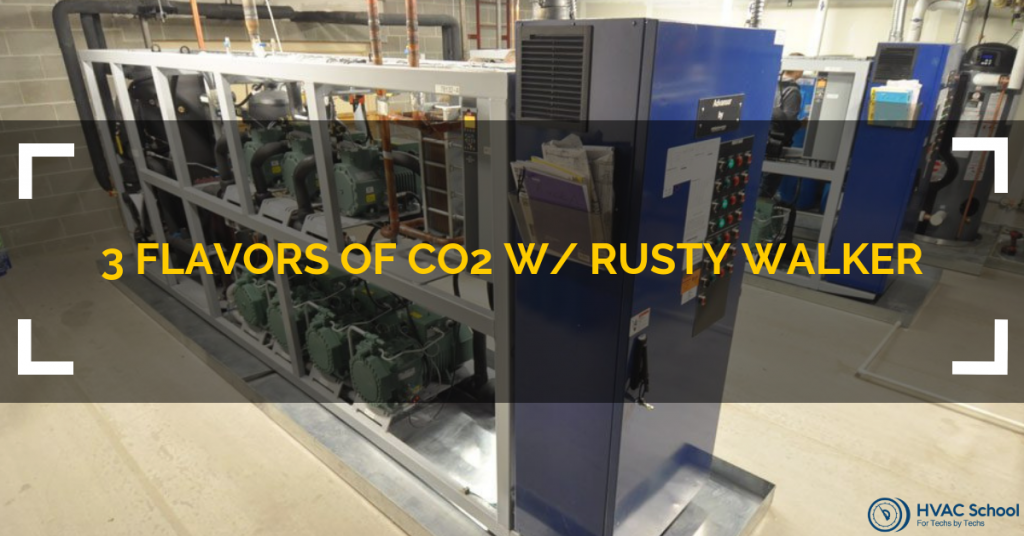
In this podcast episode, Rusty Walker from Hill Phoenix talks us through the three most common types of market CO2 systems and how they work: secondary, cascade, and booster.
Carbon dioxide (CO2) is one of the oldest refrigerants; it is a natural refrigerant that came about when toxic refrigerants like ammonia were common. In the 1980s, we began to rediscover the benefits of CO2 in market refrigeration, including its high latent heat capacity, low costs, and low global warming potential.
Secondary systems use an HFO or HFC on top, which acts as the primary system and helps discharge heat. These systems have large receivers with both liquid and vapor CO2, and they resemble glycol systems quite a bit. The actual CO2 side of the system moves a lot more heat than the primary system alone; the CO2 side absorbs heat from open cases on the sales floor.
Cascade systems are two complete refrigeration systems tied into each other. Like secondary systems, these may use an HFC or HFO with the CO2 system. A heat exchanger exists between the two systems and serves as the evaporator for the upper cascade or the condenser for the lower cascade.
Booster systems have an upper side and lower side. These may have multiple medium-temp and low-temp compressors. They also have a high-pressure control valve. That controller looks at drop leg temperature and pressure to regulate subcooling. These systems also have a flash gas bypass valve that discharges into the receiver or the medium-temp suction line.
Rusty and Bryan also discuss:
- CO2 and ammonia
- Triple point
- Supercritical fluid
- Latent heat benefits
- Metering devices
- Thermal siphon
- Heat exchangers and pressure drop
- Upper vs. lower cascades
- CO2 pressures
- Compression ratio
- Subcritical and supercritical modes
- Adiabatic operation
- Climates
You can also contact Rusty by email at rwalker@doverfoodretail.com.
Learn more about Refrigeration Technologies HERE.
If you have an iPhone, subscribe to the podcast HERE, and if you have an Android phone, subscribe HERE.










Comments
To leave a comment, you need to log in.
Log In