
Dehumidification Settings and Wiring with the Ecobee thermostat (Podcast)
Make & share a podcast clip
Keep the exact passage and a link to the full episode. Choose up to three minutes, with enough context to be fair to the speaker.
Preview uses this episode’s audio. Browser audio export, when supported, takes the length of the selected clip. Nothing plays until you choose Preview.
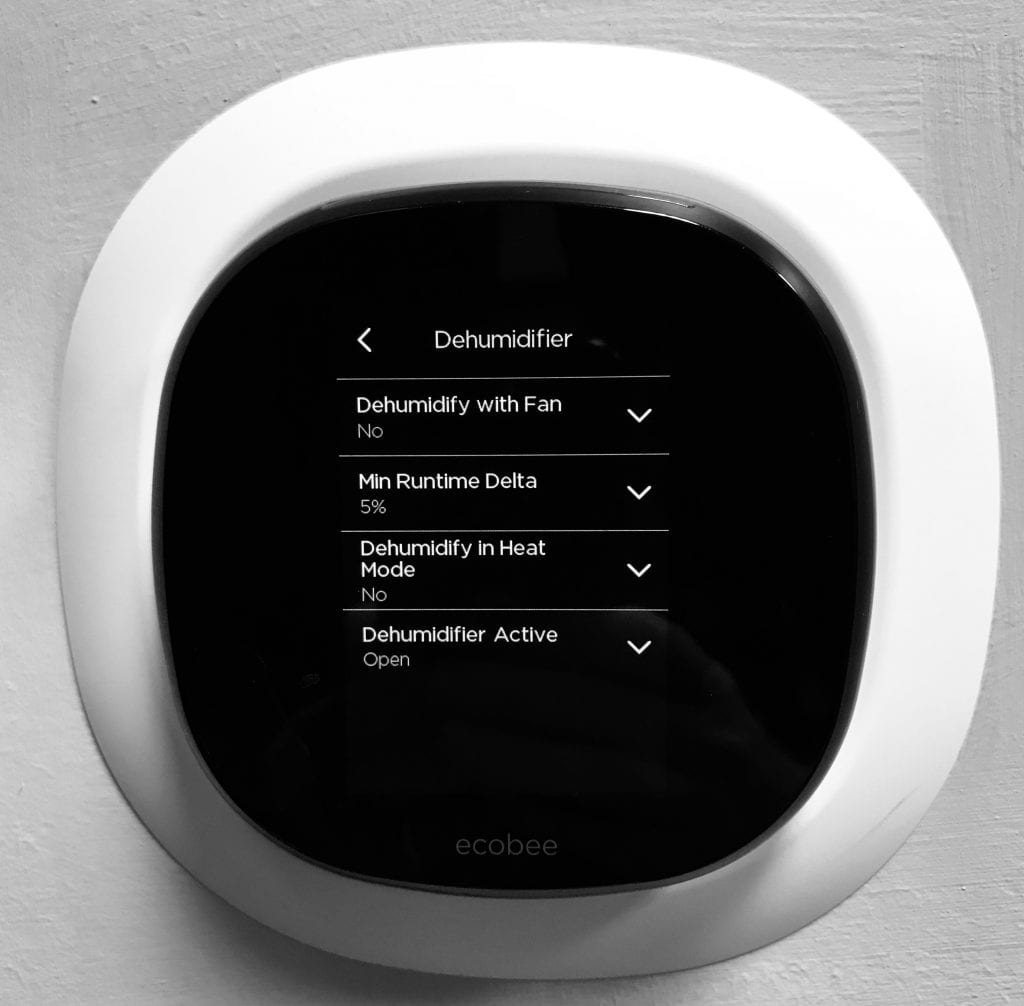
Bryan talks with Jesse and Nathan about setting up dehumidification for residential equipment in general. They also discuss some of the required and recommended settings on an Ecobee thermostat.
On typical single-stage residential equipment, dehumidification works based on CFM per ton. We control humidity by dropping the CFM across the indoor coil and extending runtime. However, as you cool the air, you reduce its ability to hold moisture. So, you increase relative humidity through cooling.
When we have achieved the desired humidity but not the desired temperature, the thermostat reduces the fan speed. Thermostats should vary the fan speed based on the call for cooling and the humidity in the air. Some systems have a dehumidification terminal; when there is a call on that terminal, the fan speed gets maxed out.
Some older thermostats would display relative humidity but did not have a dehumidification terminal; these systems would merely overcool instead of removing the humidity. These systems would be very prone to freezing. Nowadays, freezing still occurs on occasion, but our newer thermostats can control their CFM per ton much better to prevent freezing.
Ecobee thermostats work to integrate many different accessories. So, Ecobee thermostats try to solve every problem on a system, even on systems with supplementary humidifiers or dehumidifiers. These thermostats don’t have a dehumidification terminal, but they have ACC- and ACC+ terminals for accessories, including dehumidifiers. Many technicians become confused when they think that the fan is a core element of dehumidification. Instead, the ACC terminals should be set as single-transformer, and you can choose the dehumidification option (which should NOT have the fan on). When wiring the Ecobee for dehumidification, connect the DH terminal to ACC+, remove the jumpers, set up the single-power source, do NOT dehumidify with a fan, and set “Dehumidifier Active” to “Open.”
If you have an iPhone, subscribe to the podcast HERE, and if you have an Android phone, subscribe HERE.
Highlight a short passage, or bring a question about a specific moment into HVAC No Bull Forum.
Discuss this reference → Related forum discussionsAuthor:











Comments
To leave a comment, you need to log in.
Log In